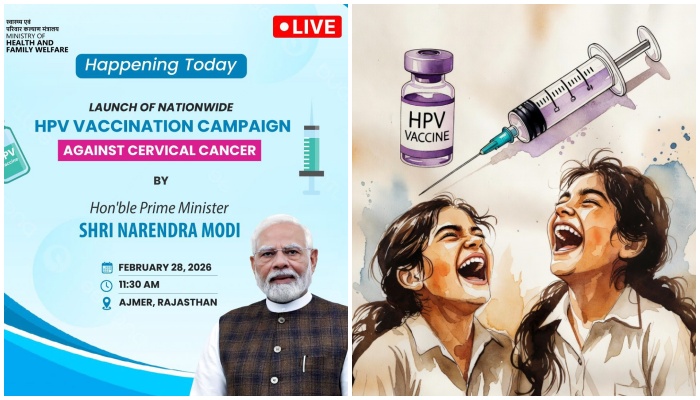
PM Modi is launching the nation-wide HPV vaccination program for teenage girls at an event today, on February 28, in Ajmer, Rajasthan. The campaign presents a landmark initiative by India’s Ministry of Health and Family Welfare (MoHFW) to combat cervical cancer through prevention.
Cervical cancer, primarily caused by persistent infection with high-risk Human Papillomavirus (HPV) strains, remains one of the leading cancers among women in India. The campaign by the government of India focuses on vaccinating young girls, specifically targeting 14-year-olds, to provide early and effective protection before potential exposure to the virus.
The nationwide rollout aims to significantly reduce cervical cancer incidence by promoting widespread HPV vaccination, building on global evidence that HPV vaccines are safe and highly effective in preventing infection and related cancers when administered prior to the years where young girls might be exposed to sexual contact, thereby running the risk of contracting the Human Papiloma Virus.
A transformative step for women’s health is set to begin!
Hon’ble Prime Minister Shri Narendra Modi will launch the Nationwide HPV Vaccination Campaign against cervical cancer in Ajmer, Rajasthan, marking a decisive move towards prevention and early protection for young girls… pic.twitter.com/ALXEUxfeIN
— Ministry of Health (@MoHFW_INDIA) February 28, 2026
It is notable here that with today’s launch, India will join over 160 countries that have introduced HPV vaccination into their immunisation schedules. More than 90 countries are implementing single-dose HPV vaccination schedules, improving coverage, affordability, and programme efficiency.
Rampant social media misinformation against the HPV vaccination drive
While the nation-wide launch of the immunisation campaign has garnered praise and support from the medical community, there is a significant level of misinformation and negative campaigning on social media, wherein people are suggesting that the vaccine might be unsafe, that it ‘is a project by evil Bill Gates’ or that the government is somehow putting young girls under risk by launching a vaccination campaign.
A lot of these claims against the HPV vaccination drive are the result of common myths and superstitions, aided by modern conspiracy theories. There are educated, privileged social media users who have been spreading misinformation against the vaccination drive and trying to peddle fear by using unrelated claims, half-baked theories and a lot of general misinformation.
Let’s break down some of these false claims and get some clarity about the vaccines
A number of social media handles have cited media reports and claims regarding a study conducted in India that involved two different vaccines, Gardasil, manufactured by Merck/MSD, and Cervarix, manufactured by GlaxoSmithKline/GSK. The study was a larger demonstration project, not strictly a “clinical trial”, because the traditional clinical trials of both the above-mentioned vaccines were already over by then.

Point to be noted here that both Gardasil and Cervarix were already licensed, and commercially available in India since 2008. The PATH study was done to test large-scale adminstration and preparedness for borader population groups, for potential nationwide roll outs at a later stage.
The study was conducted by PATH (Program for Appropriate Technology in Health), in collaboration with the Indian government, the State governments of Andhra Pradesh and Gujarat, and the Indian Council of Medical Research between 2009 and 2010. The vaccine doses of both Gardasil and Cervarix were donated by the respective manufacturers.
The PATH study, starting around 2009, aimed to assess feasibility, acceptability, coverage, and implementation of HPV vaccination strategies for potential future inclusion in public immunization programs.
In Andhra Pradesh, approximately 14,000 girls under the 10-14 age group received the Gardasil vaccine manufactured by Merck.
In Gujarat, approximately 16,000 girls in the same age group received Cervarix manufactured by GSK.
Following the study, there was some opposition, fuelled by similar anti-vaccine sentiments, activism, human rights, women rights groups and political support to such sentiments, driven by contemporary politics and some public concerns. The main objections raised was on the ‘ethical’ aspects of these studies, because there were some aspects of “improper” way of obtaining consent forms. In some places, school headmasters, or hostel wardens had signed the consent forms, while ideally it should have been parents.
There was also some nationalistic sentiments attached, because the governments, Central and State governments both, were accused of ‘collaborating’ with foreign companies and organisations to hand over crucial health data. The negative sentiments were fuelled further when activists highlighted that 7 girls, two in Gujarat and 5 in Andhra Pradesh have died following the HPV vaccination.
The news and furore around the deaths caused further political noise. An all Parliamentary Standing Committee on Health and Family Welfare (72nd Report) harshly criticized PATH, ICMR, and the Drugs Controller General of India (DCGI). It accused PATH of acting as a “willing tool” for foreign vaccine manufacturers (Merck and GSK) to push inclusion in India’s Universal Immunization Programme (UIP) for commercial gain, rather than genuine public health aims.
The reality behind the claims of “deaths after vaccination”
ICMR took the allegations of deaths seriously, and a detailed investigation was launched to examine the claims. In 2011, ICMR submitted its final report. The final report examined the autopsies, health records, local data and timelines of each death. The result? None of the 7 deaths was found to be linked to or caused by vaccines in any way.
In Andhra Pradesh, the causes of deaths found were Organophosphorus poisoning (possible pesticide consumption by a 14-year-old girl), another similar case of suspected pesticide consumption by a 13-year-old girl, one case where the exact medical diagnosis was uncertain but unlikely to be caused by vaccine, a case of accidental drowning of a 14-year-old girl, a case of malaria and typhoid.
In Gujarat, where Cervarix was administered, one death was caused by snakebite, and another was due to malaria and severe anaemia.


Claims of ‘ethical lapses’ may have been valid, but that does not mean the vaccines were dangerous or ineffective
It is notable here that the 2013 Parliamentary committee report did raise significant concerns and criticised the governments for the lapses, but that does not mean that the vaccines are ineffective or ‘dangerous.’
Here is why.
- An extensive study by ICMR, as cited above, found no correlation between the vaccines and deaths. Blanket labelling the vaccines as ‘dangerous’ because of certain ‘ethical’ or procedural irregularities flagged in a study that involved 30,000 recipients and hundreds of health workers, NGO workers and staff across two states does not make a scientific, logical argument.
- Global and Indian data at the time (and since then) has showed HPV vaccines had strong safety profiles, with no causal deaths linked anywhere.
- The parliamentary report itself has been critiqued by experts (for example, The Lancet Oncology) for ignoring extensive pre-existing evidence on HPV vaccine safety and efficacy from clinical trials and post-licensure surveillance.
- Over 15+ years and hundreds of millions of doses worldwide of HPV vaccines like Gardasil have demonstrated high efficacy (93–100% against targeted HPV types causing most cervical cancers.
- The vaccine has a an excellent safety record, with mostly mild side effects (like injection-site pain) and rare serious events.
The vaccine is fine, all cases against it have pretty much been thrown out by the court and lawyers are now reduced to pleading that recipients weren’t informed that they could feel briefly giddy after the shot. And maybe you should have read the link properly before posting. 🙂 https://t.co/0kFnGqjdJ2 pic.twitter.com/O9aljxdtzq
— Amit Thadhani (@amitsurg) February 25, 2026
Why is the current nationwide campaign using Gardasil, manufactured by Merck?
Some might ask: while the PATH study tested both Gardasil and Cervarix, why is the current Government program launched nationwide using Gardasil exclusively? Here are the main reasons.
Gardasil needs only a single dose, in contrast to GSK’s Cervarix, which needs multiple doses. The single-dose efficacy is well-established, with multiple WHO studies and has a proven record after over a decade of usage globally. Gardasil has been extensively studied and administered in over 500 million doses worldwide since 2006, with a well-established safety profile and proven impact in reducing HPV infections.
The government of India has secured Gardasil supplies through a transparent, globally supported mechanism in partnership with GAVI, the Vaccine Alliance, ensuring uninterrupted, quality-assured doses with cold-chain integrity and adequate storage facilities across the nation.
There is a Made In India HPV vaccine coming too, currently being studied
It is notable here that India already has options in the pipeline when it comes to large-scale immunisation against HPV. Serum Institute of India has developed Cervavac, another quadrivalent HPV vaccine. The vaccine has already cleared trials and is commercially available since 2023. However, it is yet to be inducted into the nation-wide immunisation program because Cervavac also needs two doses. The ICMR is conducting an immunobridging study comparing single-dose Cervavac to Gardasil for non-inferiority.
When Cervavac clears that study, it is likely to be included in the government’s campaign too. Cervavac is significantly cheaper and produced domestically by the Serum Institute of India, in contrast to Gardasil, which has to be imported. It is notable here that NTAGI has already approved Cervavac for NIP inclusion (initially as a two-dose regimen), and the Health Ministry and parliamentary panels have urged fast-tracking indigenous vaccines like Cervavac for broader UIP rollout.
Why is vaccine misinformation and fear-mongering dangerous to society?
HPV causes nearly all cervical cancers, plus many cases of anal, penile, vulvar, vaginal, and oropharyngeal cancers, as well as genital warts. India sees over 120,000 new cervical cancer cases and ~80,000 deaths annually, making prevention via vaccination a high-stakes priority.
Misinformed, half-baked and unscientific social media claims spread fear and make parents hesitant, leaving children vulnerable to preventable diseases. Usually, myths and misinformation spread fastest in vulnerable groups, the poor and uneducated families, where young girls might have a chance to stay immune to cervical cancer, are the ones most likely to suffer the worst outcomes. An affluent family can change its mind at any time and get a commercially available vaccine for their daughter. But if girls from poor families miss out on the free vaccine doses given in the nationwide campaign, they are unlikely to get it again.
Are the general negative sentiments against Bill Gates working to fuel the anti-HPV vaccination drive?
Billionaire philanthropist Bill Gates, who started the Bill and Melinda Gates Foundation, has been receiving a lot of flak recently over his links with convicted sex offender Jeffrey Epstein. The amplified anti-Bill Gates sentiments are, in a way, fuelling the global anti-vaxxer narratives, aided by conspiracy theorists who use the Epstein link to vilify Gates, and use that link to portray the overall healthcare initiatives by the Bill and Melinda Gates Foundation as some sort of sinister global corporate project.
The Bill and Melinda Gates Foundation plays a crucial role in global vaccination efforts. It provided the initial USD 750 million funding to launch GAVI with the support of WHO, UNICEF and World Bank in 1999-2000. Total contribution to GAVI by the Foundation has exceeded USD 7.7 billion so far, as per some reports. GAVI is a noble global stand against preventable diseases that has vaccinated over 1.2 billion children globally, preventing over 20 million deaths. BMGF also supports research and development, supply, pricing and procurement efforts to enable poor nations to access vaccines.
The personal life and professional conduct of Bill Gates are indeed under scrutiny over Epstein links. But that does not mean that governments across the world and organisations like GAVI, which have been saving millions of lives globally through extensive vaccination drives, will condemn teenage girls across 160 nations to uncertain dangers through some sinister vaccination agenda. Vaccines go through extensive studies, safety trials and research before they are made available to the public. The robust scientific record of HPV vaccinations and their potential efficacy against a preventable cancer should not be ignored for the sake of some unverified and unscientific conspiracy theories.