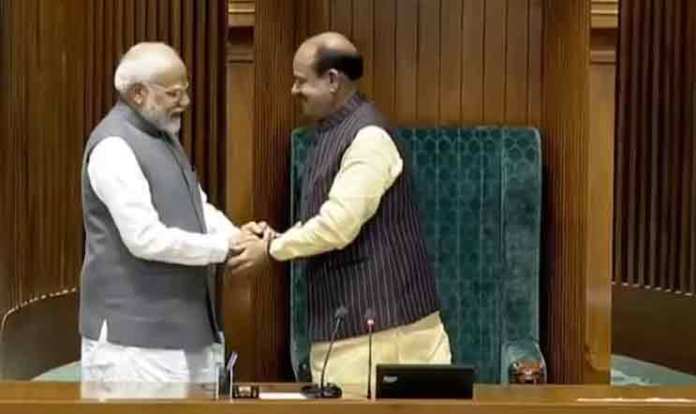

Lok Sabha Speaker Om Birla has thanked Prime Minister Narendra Modi for a letter lauding his impartiality and commitment to parliamentary traditions, following the decisive rejection of an opposition-sponsored resolution seeking his removal from office. In a post on X, Birla expressed gratitude for the Prime Minister’s message, which arrived days after the Lok Sabha defeated the motion by voice vote amid heated protests.
“Honourable Prime Minister Shri Narendra Modi ji, I have received your letter,” Mr Birla wrote. “You have always held an unwavering faith in the rules, procedures and traditions of India’s parliamentary democracy. Your letter expresses those highest ethical values of public service that you have lived by throughout your long public life — both in your current role as Prime Minister of India and previously as Chief Minister of Gujarat.”
The Lok Sabha speaker wrote, “You have always maintained a deep belief in the fundamental nature of Parliament — dialogue, debate and discussion. You respect every voice raised in the House as the voice of millions of Indian citizens. You have always given the highest priority to parliamentary business and endeavoured to resolve every issue raised in Parliament.
माननीय प्रधानमंत्री श्री @narendramodi जी,
आपका पत्र प्राप्त हुआ। भारत के संसदीय लोकतंत्र के नियमों, प्रक्रियाओं और परंपराओं के प्रति आपका हमेशा अटूट विश्वास रहा है। आपका पत्र लोक सेवा के उन उच्चतम नैतिक मूल्यों को व्यक्त करता है, जिन्हें आपने अपने दीर्घ सार्वजनिक जीवन में जिया… pic.twitter.com/2eXTMULPhw— Om Birla (@ombirlakota) March 15, 2026
He further added, “This message of yours, rising above party lines, will inspire all elected representatives in Parliament, state legislatures and local bodies, and will further strengthen the robust ethical foundation of the democracy established by our freedom fighters and the members of the Constituent Assembly. Heartfelt thanks for your inspiring words.”
In his letter to Speaker Birla, Prime Minister Modi congratulated the House on decisively rejecting what he described as a “political act” and commended the Speaker’s conduct. “The balance, patience and clarity with which you referred to parliamentary history, the responsibilities of the Speaker, and the supremacy of rules is highly impressive,” the Prime Minister wrote. He added that Mr Birla’s statement that “no one in this House is above the rules” reaffirmed the “core spirit of our democracy” and praised the Speaker’s “inspiring” discharge of duties, even amid difficult circumstances”.
PM Modi wrote in the letter to Om Birla, “The no-confidence motion brought against you in the Lok Sabha was rejected by the House. I also congratulate the members of the House for the decisive manner in which they rejected this political misdeed. I listened attentively to the statement you delivered in the House following the defeat of the no-confidence motion. The balance, patience, and clarity with which you referenced parliamentary history, the duties of the Speaker, and the supremacy of the rules were truly impressive. For this, I congratulate you.“
The PM wrote, “Your statement was not merely a response to that specific moment; it also served as a profound and measured exposition of Indian parliamentary traditions and democratic propriety. The greatest strength of Indian democracy lies in its constitutional institutions. Parliament stands as the supreme forum among these institutions. Every voice raised within this House represents the hopes and aspirations of millions of citizens across the country. In such a context, the duty of the Lok Sabha Speaker extends beyond merely conducting the proceedings; the Speaker also serves as the guardian of democratic traditions, parliamentary rules, and institutional dignity. The clarity with which you asserted in your statement—that no one in this House stands above the rules—delivers a message that reaffirms the fundamental spirit of our democracy.”
He further stated, “In a democracy, differences of opinion are natural. Indeed, it is the diversity of ideas that infuses democracy with vitality. However, it is equally true that there exists a clear distinction between disagreement and disrespect. For all those who place their faith in democracy and its institutions, it is a matter of concern that political disagreement occasionally appears to morph into disrespect for parliamentary propriety. It is in such moments that the person occupying the Chair faces their true test. The restraint, composure, and impartiality with which you navigated these circumstances are truly commendable.
Every citizen of this nation who cherishes democratic ideals sensed that the no-confidence motion brought against you was driven by motives of personal self-interest and arrogance. This turn of events caused distress to everyone who holds faith in the democratic process. This is not the first instance in which this august Chair has been compelled to confront such circumstances. Prior to your tenure, when the Honourable Sumitra Mahajan held this office, we observed that the conduct of certain members did not align with the dignity expected of all members of the House. Even at that time, on numerous occasions, instances of unwarranted acrimony and disrespect towards the Chair were witnessed. It is regrettable that such tendencies persist even today. Such conduct is not directed merely at an individual; rather, it undermines the dignity of the institution that stands as a symbol of our entire democracy.”
The PM’s letter to the speaker further stated, “The fundamental essence of Parliament lies in dialogue, reasoned argument, and deliberation. Here, every idea must be accorded the opportunity for expression. Throughout your tenure, you have consistently strived to ensure that the maximum number of Members of Parliament get the opportunity to speak in the House. Whether they are young MPs, first-time elected representatives, or women parliamentarians, providing everyone with the opportunity to voice their views serves to broaden the scope of our democracy.
The nation observes with dismay that certain individuals—driven by a dynastic and feudal mindset—seek to confine even our democratic institutions within their own limited spheres. They find it difficult to readily accept the rise of any newcomer. Furthermore, they cannot tolerate the idea that other elected representatives in the House—particularly new and young MPs—should be granted equal opportunities to speak and advance. Such a mindset runs counter to the very spirit of democracy.
The true meaning of democracy is that opportunities should not remain confined to a select few, but rather that the voices of every section of society and every region find their rightful place. Under your stewardship, you have consistently upheld and expanded this ethos. The manner in which you have discharged your duties—even amidst challenging circumstances—is truly inspiring.
I am also pleased to note that, even while shouldering such significant national responsibilities, you have never allowed the interests of the people of your constituency to take a backseat. Recently, at the foundation-laying ceremony for the airport project in Kota, we witnessed the unwavering commitment with which you have consistently strived for the development of your constituency. The equilibrium you have maintained between your national obligations and your responsibilities toward your parliamentary constituency stands as a testament to your profound dedication as an elected representative.
I am confident that you will continue to preside over the Lok Sabha with the same steadfastness, patience, and impartiality in the future. It is a shared responsibility for all of us to uphold the prestige of our democratic institutions and to further strengthen them. The dignity and dedication with which you are discharging this duty will undoubtedly serve to further fortify our parliamentary democracy.”
The exchange comes after the no-confidence motion, formally a resolution under Article 94(c) of the Constitution for the removal of the Speaker, was tabled by Congress MP Mohammad Jawed and supported by 118 opposition MPs. The opposition accused speaker Birla of partisan conduct, including the suspension of a record number of MPs, repeatedly curtailing opposition speeches (particularly those of Leader of the Opposition Rahul Gandhi), and failing to fill the long-vacant post of Deputy Speaker.
The motion, only the third of its kind in independent India’s history, was debated over nearly 12 hours across two days during the Budget Session. Union Home Minister Amit Shah led the government’s defence, accusing the opposition of undermining democratic institutions and highlighting increased productivity under Om Birla’s tenure, including extended Zero Hour sessions and opportunities for all 78 women MPs to speak. Opposition members protested loudly, demanding an apology from Amit Shah over remarks about Rahul Gandhi’s conduct, and the motion was ultimately rejected by voice vote.
Om Birla had recused himself from presiding during the debate. Upon returning to the Speaker’s chair the following day, he firmly rejected allegations of bias. “Every honourable member, whether the Leader of the House, the Leader of the Opposition, a minister or any other member, has the right to speak in the House only in accordance with the rules and procedures,” he said. “No one is above the rules. Let us run this Lok Sabha with rules and regulations that apply equally to the opposition and the government alike.”