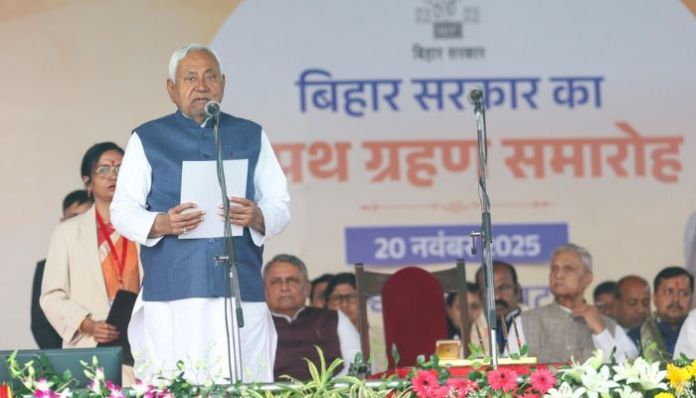

Nitish Kumar took oath as the Chief Minister of Bihar for a record 10th time on Thursday, 20th November, marking another milestone in his long political journey that has shaped the state’s politics for more than two decades. The oath-taking ceremony was held at Patna’s historic Gandhi Maidan, a place deeply linked with Bihar’s political past.
VIDEO | JD(U) Supremo Nitish Kumar (@NitishKumar) takes oath as Bihar CM at Patna’s Gandhi Maidan.
(Full video available on PTI Videos – https://t.co/n147TvrpG7) pic.twitter.com/1LEqwPIQah— Press Trust of India (@PTI_News) November 20, 2025
It was at the same venue that Kumar had taken oath in 2005, 2010, and 2015, and where Jayaprakash Narayan once made his famous call for a “total revolution” in 1974.
A total of 26 ministers took oath on Thursday, out of which 14 are from BJP, 8 from JD(U), 2 from LJP(RV) and one each from HAM and RLM.
The BJP MLAs who took oath as ministers are Samrat Choudhary, Vijay Kumar Sinha, Dilip Jaiswal, Mangal Pandey, Ram Kripal Yadav, Sanjay Singh Tiger, Nitin Nabin, Arun Shankar Prasad, Surendra Mehta, Narayan Prasad, Rama Nishad, Lakhendra Roshan, Shreyashi Singh and Pramod Kumar. Samrat Choudhary and Vijay Kumar Sinha have been been made Deputy CMs.
The new JD(U) ministers are Vijay Kumar Chaudhary, Vijendra Kumar Yadav, Shravan Kumar, Leshi Singh, Ashok Chaudhary, Madan Sahni, Sunil Kumar and Mohd Zama Khan. From LJP(RV), Sanjay Kumar and Sanjay Kumar Singh have been inducted in the ministry. Santosh Kumar Suman from HAM and Deepak Prakash from RLM are also new ministers.
Prime Minister Narendra Modi, Union Home Minister Amit Shah, and several senior leaders of the National Democratic Alliance were present at the grand ceremony. Chief Ministers from other NDA-ruled states also attended the event, showing their support for Nitish Kumar as he begins yet another term as Bihar’s leader.
On Wednesday, 19th November, Nitish Kumar was unanimously chosen as the leader of both the JD(U) Legislature Party and the NDA Legislature Party during meetings attended by the newly elected MLAs. This decision officially paved the way for him to head the new government.
In the BJP, senior leaders Samrat Choudhary and Vijay Kumar Sinha were elected as the leader and deputy leader of the Legislature Party. The proposal for their appointments was moved by Uttar Pradesh Deputy Chief Minister Keshav Prasad Maurya, who acted as the central observer, and was supported by all BJP MLAs.
The 2025 Bihar Assembly elections were seen as a major test for the 74-year-old leader who has been at the centre of state politics for over 20 years. Nitish Kumar first became Chief Minister in the year November 2005 and, except for a brief nine-month break between 2014 and 2015, he has continued to lead the government.
After the National Democratic Alliance’s huge victory in the polls, winning 202 out of 243 seats, Nitish Kumar met Governor Arif Mohammad Khan on Wednesday, 19th November evening, to formally stake a claim to form the government. This is only the second time the NDA has crossed the 200-seat mark in Bihar’s history, the first being in 2010 when it won 206 seats.
Among the NDA partners, the BJP secured 89 seats while Nitish Kumar’s JD(U) won 85. Chirag Paswan’s Lok Janshakti Party bagged 19 seats, Hindustani Awam Morcha led by Jitan Ram Manjhi won 5, and the Rashtriya Lok Morcha got 4 seats. On the opposition side, the Rashtriya Janata Dal (RJD) managed 25 seats, the Congress won 6, the CPI(ML)L got 2, and the CPI(M) and Indian Inclusive Party won one seat each. The AIMIM won 5 seats, and the Bahujan Samaj Party (BSP) secured 1.
The two-phase elections were held on November 6 and 11 and recorded a voter turnout of 67.13 %, the highest since the first Assembly election in 1951. Women once again outnumbered men at the polling booths, with 71.6 % female turnout compared to 62.8 % for men, continuing the trend of strong participation by women voters in Bihar.
With this oath, Nitish Kumar now begins his tenth term as Chief Minister, reinforcing his image as one of Bihar’s most experienced politicians. As he steps into his new term, the focus is expected to be on continuing development work, improving governance, and strengthening the NDA’s position in the state as it moves forward.