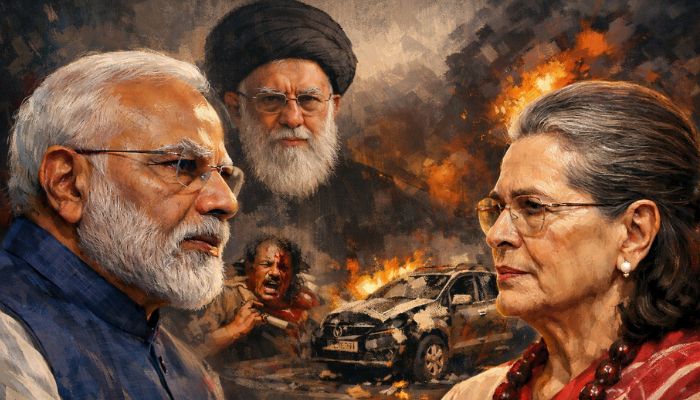
On 3rd March, Congress leader Sonia Gandhi accused the Modi Government of moral abdication for not issuing an emphatic public condemnation over developments involving Iran. In an op-ed published in the Indian Express, she attempted to cast calibrated diplomacy as complicity and restraint as surrender. The argument presented by the Congress leader was designed for political effect.
Furthermore, it is also one that does not withstand even a modest examination of the Congress Party’s own record when it was in power at the Centre. India’s foreign policy has rarely been conducted through loud moral declarations. India has always shaped its foreign policy while keeping national interest, strategic balance and institutional prudence as its priorities. This principle did not begin in 2014 when Prime Minister Narendra Modi took charge of office. It was equally visible under the United Progressive Alliance government under Prime Minister Manmohan Singh, with Sonia Gandhi having a strong hold on the decision-making processes.
The Libya precedent that Congress prefers to forget
In October 2011, Muammar Gaddafi was captured and killed during the Libyan uprising amid a NATO backed intervention. The way Gaddafi was killed raised significant questions about sovereignty, regime change and the limits of international intervention. A sitting head of state was eliminated in the course of an externally supported conflict. If ever there was a moment to invoke the sanctity of sovereignty or to lecture the international community on moral responsibility, this was it.
But what did the Congress-led UPA government do at that time? It issued a restrained statement expressing concern about the situation in Libya and hoped for peace and stability in the country. There was no dramatic condemnation of the manner of Gaddafi’s execution. There was no invocation of Article 2(4) of the United Nations Charter, which Sonia Gandhi invoked in her recent op-ed.
There was no rhetorical positioning about India’s civilisational duty to speak up. The response was measured, cautious and deliberately understated. At that time, no one claimed that India’s calibrated response amounted to complicity. No one accused the government of moral abdication.
The UPA understood that Libya was in turmoil, that NATO powers were directly involved, and that India had already adopted a cautious position in the Security Council. It chose diplomatic restraint because that served India’s interests. That approach was described as prudence and maturity.
If restraint in 2011 was prudent statecraft, why is restraint today described as moral collapse?
The 2012 Israeli diplomat car blast and the reality of calibrated statecraft
The answer to Sonia Gandhi’s question becomes clearer when the incidents and the aftermath of the attack on the Israeli diplomat in February 2012 in New Delhi are examined. On 13th February, a sticky bomb was attached to the car of the wife of an Israeli diplomat in New Delhi. The incident took place barely 200 metres away from the Prime Minister’s residence.
It cannot be seen as a distant conflict. It was a direct security breach on Indian soil, that too in the heart of the capital. The attack had immediate diplomatic implications involving Israel and potentially Iran.
Under Prime Minister Manmohan Singh, India responded firmly. The Ministry of External Affairs condemned the attack and later issued a statement in March 2012 about arrest warrants being issued against Iranians in the matter. However, they were never brought to India.
The External Affairs Minister assured Israel that the law of the land would take its course. Security around diplomatic missions was tightened. India gave a clear message that it would not tolerate violence on its soil.
As the investigation progressed, Delhi Police identified Iranian nationals as suspects. Israel claimed that Iran’s Revolutionary Guards were behind the attack. Later, Delhi Police also asserted the same during investigation. Media reports indicated that phone records and financial transactions were being examined.
Letters rogatory were sent under Section 166A of the Criminal Procedure Code to Iran, Georgia, Malaysia, Israel and Thailand. A Delhi Police team travelled to Tehran seeking cooperation. The matter was raised through diplomatic channels. Parliament was informed of investigative progress and recoveries, including vehicles and electronic devices allegedly linked to the case.
During the investigation, Delhi Police arrested Indian journalist Syed Mohammad Ahmed Kazmi, alleging that he had facilitated contacts linked to Iranian operatives. The arrest was placed on record in Parliament. Letters rogatory were sent to Iran and other countries seeking cooperation. The government pursued the case through legal mechanisms. When the Supreme Court granted Kazmi procedural bail on statutory grounds relating to remand timelines, the UPA government filed a review petition.
However, as time passed, the kind of pressure that the Indian government under PM Singh, with Sonia Gandhi in the background, should have built, in line with what Gandhi now wants the Modi government to do, did not take shape. The UPA government did not escalate into public diplomatic confrontation with Iran at the highest political level.
While accused of similar incident in Bangkok got life imprisonment, the cases involving Kazmi in India are still ongoing. OpIndia checked the status of the cases in both Delhi High Court and in a Session Court in Delhi and found that the Delhi High Court is listed for final disposal in May 2026 and in Sessions Court, it is listed for hearing in March.
It did not issue sweeping condemnations of the Iranian state. It did not convert the investigation into a moral crusade. Instead, it pursued legal and diplomatic processes while maintaining broader strategic engagement. That was not silence. It was calibrated statecraft.
Balancing Iran, Israel and global pressures
The 2012 episode unfolded in a delicate geopolitical environment. India had longstanding energy ties with Iran and relied significantly on Iranian crude. At the same time, defence and intelligence cooperation with Israel was deepening. The United States was increasing scrutiny of countries engaging with Tehran amid sanctions linked to Iran’s nuclear programme. The Non-Aligned Movement summit was held in Tehran that year, and India participated despite Western reservations.
No one at the time suggested that attending NAM in Tehran while investigating Iranian suspects was appeasement. It was understood as strategic balancing. If we equate the Modi Government’s current stand with the UPA one, the government neither surrendered to Iran nor publicly humiliated it. It navigated a complex terrain through institutional channels. This is exactly what the PM Modi-led government is doing.
If that approach was called strategic autonomy in 2012, how does similar calibration now become abdication?
The selective outrage in the present moment
Against this backdrop, Sonia Gandhi’s present charge appears inconsistent. She suggests that failure to publicly condemn certain developments amounts to moral abdication. Yet her own party’s record shows that calibrated diplomacy has long been India’s approach in complex international crises.
When Gaddafi was killed, restraint prevailed. When Iranian suspects were named in a bombing in Delhi, investigation and diplomacy proceeded without rhetorical escalation. When geopolitical tensions were high, India preserved room for manoeuvre. The UPA did not equate silence with complicity. It equated restraint with strategic space.
Foreign policy under the Congress was guided by national interest, not by public moral theatre. It is guided by national interest now, and it is in a much better state compared to the UPA-led government before 2014.
Foreign policy is not a platform for selective memory
The core problem with the present criticism is not that it demands moral clarity. It is that it applies that demand selectively. Calibrated response is portrayed as weakness only when exercised by a political opponent. The same calibrated response, when exercised by one’s own government, is described as prudence and maturity.
India’s foreign policy tradition across governments has emphasised sovereignty, strategic autonomy and measured language. It has avoided rushing into public moral binaries in matters involving major powers. It has relied on legal mechanisms, diplomatic engagement and institutional process. That continuity can be traced from the Vajpayee years through the UPA and into the present.
Selective memory cannot become the basis of selective outrage. If restraint in 2011 was not abdication, if calibrated engagement with Iran in 2012 while investigating Iranian suspects was not surrender, then similar calibration today cannot be branded moral failure simply because the political leadership has changed.
Foreign policy is not about who speaks louder. It is about who protects India’s interests more effectively. It is about managing competing relationships without narrowing strategic options. It is about balancing values with realism.
On that metric, consistency matters far more than sermons. Sonia Gandhi’s present moral lecture does not reveal weakness in current policy. It reveals an uncomfortable continuity, the Congress-led government practised the same calibrated realism that it now seeks to criticise.