


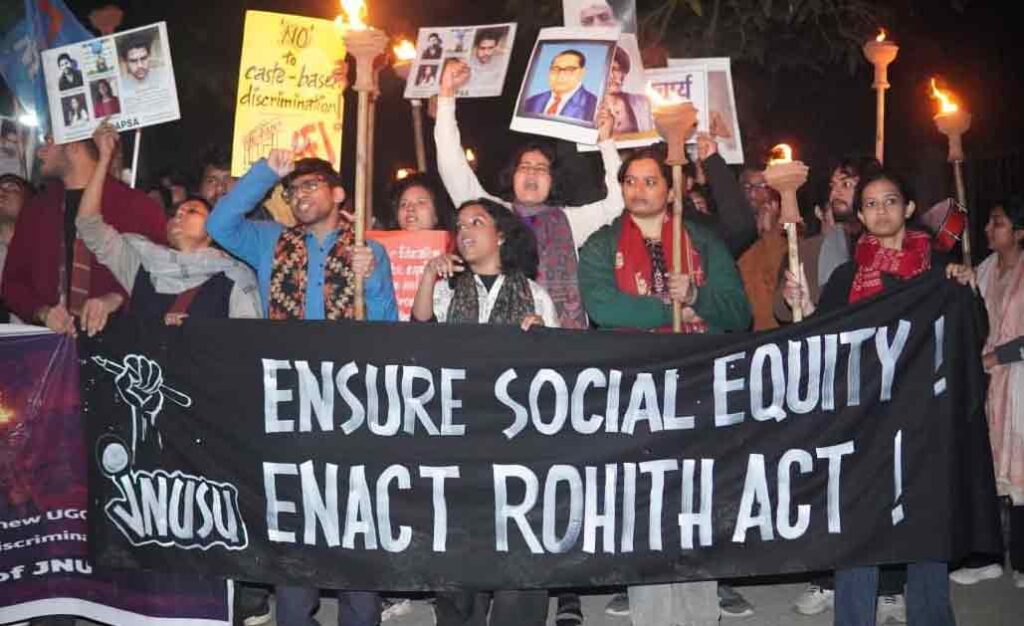
Jawaharlal Nehru University (JNU) remains gripped by student unrest as the Jawaharlal Nehru University Students’ Union (JNUSU) continues its indefinite strike against the rustication of five student leaders, the installation of facial recognition technology in the campus library, and demanding the implementation of University Grants Commission (UGC) anti-discrimination regulations stayed by the Supreme Court. The protests, which have seen heavy police presence and detentions, escalated following remarks by Vice-Chancellor Santishree Dhulipudi Pandit, prompting demands for her resignation.
Addressing the situation, the JNU posted a statement on its official X account defending the administration. The university stated that NUSU protesters are demanding the implementation of UGC regulations, emphasising that the university can’t implement the regulations stayed by the Supreme Court of India. The statement said that the Vice-Chancellor and Registrar lack authority over such matters.
The JNU said that the protestors are ignoring the “core issue,” the rustication of students for alleged vandalism and violence against public property. It added, “As per university administration, JNUSU until today has refused to address the core issue of their rustication which is the issue of vandalism and violence against public property unleashed inside campus. The involved students were held responsible and rusticated, following a proctorial inquiry.”
JNUSU protestors are demanding UGC regulations to be implemented. This is in violation of the Honorable Supreme Court which issued a stay on the regulations. JNU Vice Chancellor or Registrar have no powers over the regulations.
As per university administration, JNUSU until today…— Jawaharlal Nehru University (JNU) (@JNU_official_50) February 26, 2026
The statement added, “JNU is a public university hence accountable to the Government, the Parliament and the Indian taxpayers.” The university further stated that it is “deplorable that a woman OBC Vice Chancellor is instead attacked on false allegations, only to divert from the issue of violence and vandalism of public property.”
The rustications, issued on February 2, targeted four current JNUSU office-bearers, President Aditi Mishra, Vice President Gopika K Babu, General Secretary Sunil Yadav, and Joint Secretary Danish Ali, along with former president Nitish Kumar. They have been barred from campus for two semesters and fined ₹20,000 following a proctorial inquiry into an incident in November 2025, where protesters allegedly damaged newly installed facial recognition gates at the Dr. B.R. Ambedkar Central Library, causing an estimated ₹20 lakh in losses and injuries to security personnel.
Protests against the biometric system began in August 2025, with students labelling it a “surveillance apparatus” that infringes on privacy and academic freedom. The gates were installed amid student union elections, intensifying opposition. JNUSU has framed the rustications as a “crackdown on dissent,” leaving the campus in a “representation vacuum.”
On February 16, hundreds gathered inside the campus to demand revocation of the orders, enactment of UGC guidelines, and the removal of acting librarian Manorama Tripathi. Tensions peaked when a planned “long march” to the Ministry of Education was halted by Delhi Police and Rapid Action Force, leading to the detention of 40-50 students, including Kumar.
Protesters broke barricades at the university gate, chanting slogans like “Down with Brahminism, down with Thakurism”. They are also targeting Vice Chancellor Santishree Dhulipudi Pandit over her comments criticising the UGC’s 2026 Promotion of Equity Regulations as promoting “permanent victimhood.”
The UGC regulations, notified on January 13, aimed to address caste-based discrimination and student suicides by mandating anti-discrimination cells and penalties for violations. However, they faced backlash from general category students, who argued they were vague, divisive, and prone to misuse against general category students and faculty. On January 29, the Supreme Court stayed the rules, citing potential to “divide society,” and reverted to the 2012 guidelines pending further review.