


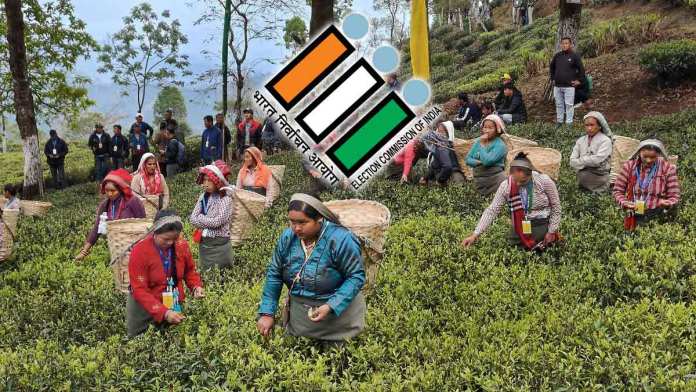

The Election Commission of India (ECI) has agreed to accept employment records from tea gardens and cinchona plantations as valid documents for the Special Intensive Revision (SIR) of electoral rolls in West Bengal for 2026.
The decision was conveyed through an official letter issued on Sunday, 11th January, sent to the Chief Electoral Officer of West Bengal. Signed by Under Secretary Shakti Sharma, the letter stated that the Election Commission has “no objection” to the state’s proposal to recognise these employment records as proof of identity and residence. The approval applies to several districts in North Bengal, including Darjeeling, Kalimpong, Jalpaiguri, Alipurduar, Cooch Behar, North Dinajpur and South Dinajpur.
The development was shared on social media by BJP IT cell chief Amit Malviya, who described it as an important step towards bringing long-marginalised communities into the electoral process. In his post, Malviya said, “this landmark decision applies to the districts of North Bengal, where hardworking tribal communities, forest dwellers, and garden workers have for years been denied their democratic rights due to documentation hurdles and the callous neglect of the state government.”
A BIG WIN FOR BJP BENGAL!
The long-ignored voices of North Bengal have finally been heard and justice has prevailed.
The Election Commission has APPROVED our request to recognise employment records of Tea Gardens and Cinchona Gardens as valid proof of identity and residence for… pic.twitter.com/7zoNd0xkH7— Amit Malviya (@amitmalviya) January 11, 2026
He pointed out that many workers in tea and cinchona gardens do not possess standard identity documents and often rely only on employment records issued by plantation authorities. According to him, the lack of land ownership, combined with poor implementation of the Forest Rights Act, 2006, has kept several generations of tea garden workers, tea tribes and forest-dwelling communities out of voter lists.
Malviya thanked the Election Commission and state election officials for addressing the concern and said the decision would allow thousands of eligible citizens to finally exercise their right to vote. He also acknowledged the support of Leader of Opposition Suvendu Adhikari, who had repeatedly urged the ECI to prevent voter exclusion during the revision process on 6th January.
Tea garden workers, many of whom belong to Adivasi and Gorkha communities, form a politically important group in North Bengal. The approval is expected to help increase voter participation ahead of the 2026 West Bengal Assembly elections. So far, there has been no official response from the Trinamool Congress or the state government.