


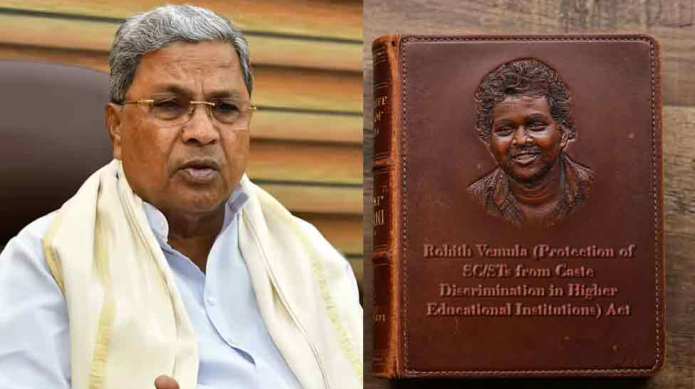


The Congress government in Karnataka has announced plans to implement the Rohith Vemula (Protection of SC/STs from Caste Discrimination in Higher Educational Institutions) Act across all educational institutions in the state, even as similar national guidelines from the University Grants Commission (UGC) remain stayed by the Supreme Court. Chief Minister Siddaramaiah made the announcement during the state budget presentation, stating that the Rohith Vemula Bill will be enacted to prevent atrocities on caste lines against students in all government, private, and deemed universities.
The proposed legislation is named after Rohith Vemula, the scholar whose death by suicide in 2016 at the University of Hyderabad led to widespread protests against alleged caste-based discrimination on Indian campuses.
The draft of the bill was discussed in a cabinet meeting on 26 February, and it will be finalised after incorporating inputs from the Home department before being placed before the next cabinet for approval. Once enacted, the law aims to provide stronger protections for students from marginalised communities, addressing gaps in existing mechanisms.
The Karnataka government’s decision comes as its commitment to action on caste discrimination in education, fulfilling a promise made in the Congress manifesto and reinforced by Leader of the Opposition in Lok Sabha Rahul Gandhi, who had urged Siddaramaiah last year to introduce such a law.
The bill’s exact provisions, including potential penalties and enforcement mechanisms, are expected to be clarified once finalised. The government has emphasised that the legislation will apply uniformly to all higher education institutions in the state, aiming to ensure students can pursue education with dignity free from caste-based exclusion or injustice.
This move comes despite the Supreme Court’s interim stay on similar provisions under UGC (Promotion of Equity in Higher Education Institutions) Regulations 2026, which were notified earlier this year to tackle alleged caste discrimination and promote equity in higher education nationwide. The apex court put the regulations on hold on 29 January 2026, citing vagueness in key provisions and the potential for misuse, while directing that the earlier 2012 UGC regulations continue to apply until further orders.
A bench comprising Chief Justice Surya Kant and Justice Joymalya Bagchi placed the regulations in abeyance, citing prima facie concerns over their vagueness in key provisions and the potential for misuse. The court observed that certain aspects of the regulations appeared “too sweeping” and could lead to “very dangerous impacts,” including the risk of dividing students like separate caste-based hostels.
The stay came in response to multiple petitions challenging the 2026 regulations, particularly the definition of “caste-based discrimination” under Clause 3(c), which limited protection to members of Scheduled Castes (SC), Scheduled Tribes (ST), and Other Backward Classes (OBC), without extending similar safeguards to general category students. The bench flagged this asymmetrical approach as raising constitutional questions, suggesting it might unfairly discriminate against upper castes and lack mechanisms to penalise false complaints.
Given the observations of the Supreme Court, it will have to be seen whether the Karnataka law will incorporate safeguards to prevent misuse.