


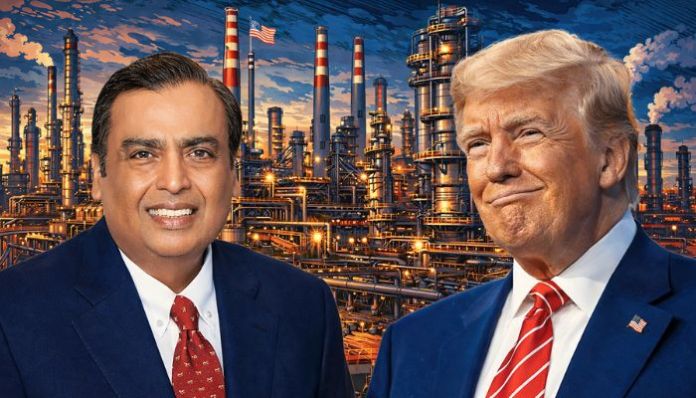

On 10th March (local time), US President Donald Trump announced that a new oil refinery in Brownsville, Texas would be part of a “historic $300 billion deal”. He called it the largest energy deal in US history.
— Rapid Response 47 (@RapidResponse47) March 10, 2026
In his post on social media platform Truth Social, Trump said India’s Reliance Industries was involved in the project. He credited his administration’s “America First energy agenda” for attracting the investment. The announcement described the refinery as a major economic project that would boost American energy production, create thousands of jobs, strengthen national security and power global exports.
Furthermore, Trump framed the project as a sign that large energy investments were returning to the United States because of policies focused on domestic production and streamlined regulatory approvals.
What the project actually involves
According to the press release issued by America First Refining, the company is planning the refinery at the Port of Brownsville in Texas, which is close to the US-Mexico border. The facility is expected to produce around 1,68,000 barrels of crude oil per day. It is designed specifically to refine light shale oil produced in the United States.
Media reports suggest that constructing a refinery of this size typically costs several billion dollars, not hundreds of billions as said by Trump. Based on typical refinery construction costs per barrel of capacity, it is estimated that a project of this scale could cost roughly $6 to $7 billion to build.
The project therefore represents a normal large energy infrastructure investment, rather than a $300 billion capital project.
Reliance’s role in the project
Trump, in his post, specifically mentioned a major financial commitment from Reliance. However, statements issued by the project developers indicate that Reliance has made a “nine figure investment”, which means the investment likely ranges between $100 million and $999 million.
Also, Reliance has signed a 20-year offtake agreement with the refinery. This agreement commits that the company will purchase the petroleum products produced by the facility over the next 20 years. In simple terms, it makes Reliance a long term buyer and commercial partner, rather than the primary investor funding construction of the refinery.
The involvement of Reliance is also notable because it already operates the massive Jamnagar refining complex in India. It is widely regarded as the largest oil refinery in the world.
Where the $300 billion number comes from
The $300 billion figure mentioned by Trump in his post does not represent the cost of building the refinery or the size of Reliance’s immediate investment. Instead, the number refers to a projected long term economic impact calculated over many years.
According to project statements, this estimate combines multiple elements including the value of shale oil that will be processed over time, the total value of refined products produced by the facility, potential improvements in the US trade balance, as well as job creation and broader economic activity generated by the project.
Such estimates are commonly used in infrastructure announcements to describe lifetime economic impact, rather than direct financial investment.
Why the refinery is being proposed
The project is being designed to process American light shale oil. It has become increasingly abundant due to the growth of fracking in US shale basins. Several existing refineries along the US Gulf Coast were originally configured to process heavier imported crude oil. As a result, some of them are not optimised for the lighter crude produced domestically.
This new facility would help increase the amount of American shale oil refined within the United States instead of being exported as raw crude.