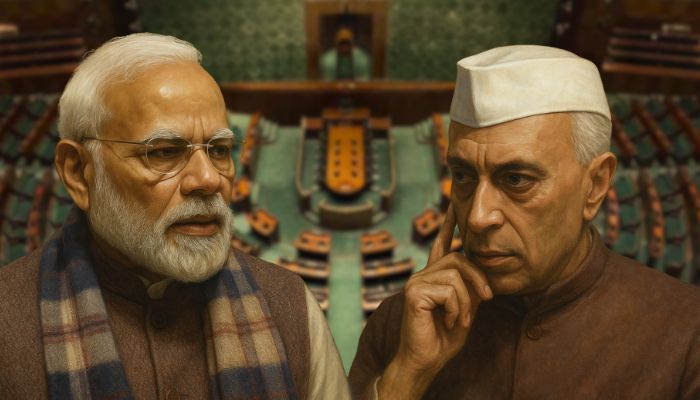
The latest storm over Vande Mataram in Parliament has revived an old ideological battle in the country. Prime Minister Narendra Modi has accused the Congress of having “fractured” the national song under pressure from the Muslim League. He accused Jawaharlal Nehru of “betraying” the song. As the government commemorates 150 years of the composition of the legendary song, the Opposition’s strong objections, counter-accusations and protests outside Parliament have brought the debate to the centre of national politics once again.
On the surface, it may look like a disagreement over a song. However, it has reopened deeper questions about the nature of India’s national identity and the historical consequences of allowing religious objections to dictate public symbols.
How the original objections were framed
The roots of the dispute date back to the 1930s, when Bankim Chandra Chattopadhyay’s Vande Mataram had already become an emotive rallying point in the national movement. However, the Muslim League, under Muhammad Ali Jinnah, rejected the song outright and claimed that bowing to the Motherland amounted to idolatry. He claimed that Anandamath, the novel in which the song appears, presented a hostile portrayal of Muslim rulers.
Jinnah used this argument repeatedly. He portrayed the Congress’s use of Vande Mataram as a deliberate attempt to undermine Muslims. His rhetoric attempted to turn a national symbol into a marker of communal divisions.
These objections soon influenced the Congress leadership. In October 1937, the Congress Working Committee decided that only the first two stanzas would be sung at public functions. It was a compromise justified on the ground that the remaining stanzas might conflict with the “religious ideology” of some groups.
The decision followed internal exchanges between leaders such as Jawaharlal Nehru and Subhas Chandra Bose. Nehru claimed in a letter that the novel’s background might “provoke Muslims” even as he dismissed much of the outcry as “manufactured by communalists”.
How national leaders interpreted the issue
There were several leaders in that era who understood the danger of repeatedly yielding to objections framed in religious terms. For example, Sri Aurobindo argued vigorously that Vande Mataram was an invocation to the Motherland, not a theological offering. He warned that rejecting national symbols to appease sectarian anxieties would damage unity.
Dr BR Ambedkar was thoroughly critical of the idea of seeing the country as “Mother India”. He rejected the idea and in fact coined the term “Bahishkrit Bharat” (Outcast India), claiming it represents the true sense of divided Indian society.
MK Gandhi, in 1905, when he was in South Africa, wrote, “The song Vande Mataram, composed by Bankim Chandra, has become extremely popular throughout Bengal. During the Swadeshi movement, massive gatherings were held in Bengal where hundreds of thousands assembled and sang this song of Bankim.” He added, “This song has become so popular that it has become like our national anthem. Its emotions are noble and it is sweeter than the songs of other nations. Its sole purpose is to awaken the spirit of patriotism within us. It regards Bharat as a mother and offers praises to her.”
Although deeply appreciative of the song’s role in the freedom struggle, argued in the late 1930s that it should not be sung at gatherings where objections were raised. His advice, which was published in Harijan, reflected a desire to avoid confrontation in a period of rising communal tension.
Responding to the letters from Bose and Nehru, Rabindranath Tagore explained that he valued the tenderness and devotion in the first two stanzas. However, he added that he recognised that the larger poem, read together with the novel, could be misinterpreted. He believed that the truncated version had gained an independent identity and should be retained for national events.
The ramifications of the decision to use only two stanzas were visible. The accommodation validated the Muslim League’s belief that objections based on religious interpretations could dictate national practice. This helped the Muslim League to push the separatist narrative, which steadily grew in confidence through the 1940s and ultimately led to the formation of Pakistan.
Why the logic of the objections remains unchanged
In the current scenario, the Opposition’s arguments bear a striking resemblance to the ones advanced by separatist leaders in the pre-Independence era. The demands remain the same, that the national symbols must be reshaped, restricted or discarded if a religious interpretation finds them objectionable.
This insistence that religious sentiments must supersede collective national identity reflects the intellectual foundation of the two nation theory, which held that Hindus and Muslims represented distinct civilisations that were incapable of sharing a single national framework unless the majority continually compromised its cultural space.
Historically, once this principle took root, it did not remain confined to songs or symbols. It expanded into demands for separate electorates, distinct laws and political safeguards built around the idea that communal identity was superior to national identity. This is the reason there is so much opposition to the Universal Civil Code (UCC) and this is the reason why Congress-ruled states are trying to woo their natural voter base with laws like the Hate Speech Bill. The end-point to this worldview was Partition of the country, not by accident but by ideological design.
Why the debate today is not about a song
Almost a hundred years have passed and the argument has resurfaced in a new form. The resistance to Vande Mataram has always been there in different circles. Resistance to the song has happened in functions, State Assemblies and in meetings. However, it no longer hinges on the literary content of Anandamath or any genuine grievance.
Instead, it reflects the larger ideological position that national symbols must remain subject to a religious veto. This position, which is built upon the logic that one community’s theological reading deserves primacy over collective national sentiment, is inherently aligned with the two nation theory. It reiterates the idea that India cannot have a shared civilisational identity unless the majority continuously curtails its cultural expressions.
Rejecting Vande Mataram in 2025 is not a matter of “choice” or “interpretation”. It is a continuation of the same separatist logic that once divided the country. The reverence for the Motherland cannot be considered sectarian unless one chooses to interpret national identity through a purely religious lens.
A dispute that still tests India’s unity
The debate over Vande Mataram is not going to end in Parliament. The ideological fault line will remain the same as it was in the 1930s. The issue is not about the two stanzas or four which should be sung. It is whether India defines its national identity through a shared civilisational consciousness or through a patchwork of religious vetoes.
The continuity of the controversy over the national song has shown that it is more than a historical composition. It is a measure of how India balances its pluralism with its unity. It does not matter what the outcome of the debate in Parliament will be, as it will not unite India’s communities divided over religious interpretations. It, however, reaffirms that “Unity in Diversity” is only a mask that will go off the moment one community starts opposing national symbols over religious readings.